FMP Developing my Technical Drawing

This week, I studied my technical drawings to improve this area in which I felt was one of my weaker sides. There was one area that I really wanted to improve and that was my technical drawings. Not being as confident with illustrator, I do find it hard sometimes to make my technical drawings look professional and clear.  One of my tutors advised me how to do it without illustrator. Using different thickness of pens to create a clean and clear idea of  details on the garment. By doing this it would make it clear for the pattern cutters to fully understand, and be able to follow clearly your designs without making any mistakes. First wanting to draw something simple with minimal detail so that I could focus on the details and what suits me when drawing. With a piece of clothing that has symmetry such as the bomber jacket, one of my tutors advised me to fold the layout paper in half so then we would be able to trace the exact same shape to get a perfect identical shape on both sides. While doing my drawings I found it hard with the details such as the zip and where the sewing would be. To problem solve, next time when I make a technical drawing for one of my garments, I will make the template of the model bigger so that it easier for me to draw in the details at a bigger scale as I kept making the zip to big on the original size model. I found that focusing on one area that I struggle with really helped me to find my own way of drawing instead of using illustrator.  Then taking my drawing to the printer to experiment with scaling of the drawing. By scaling down the image it makes the drawing look more professional and clear which you can then place onto a final line up.

FMP Sample toiling

One thing that I found when looking through my nan’s objects and furniture was not so much the shape but the detailing. Most of the detailing is on plain coloured objects as most of her furniture and wallpaper is covered in flowers. Having the detailing on plained coloured objects helps for the detailing to stand out against patterns behind. However, I didn’t just look at the detailing on her furniture, I wanted to also look at some of her clothing and what she wears in her old age because the furniture that you see from her flat are from when she was young and first moved in. I first looked at my nan’s nappies to show her old age and the time that she has been living in her flat. I saw on the edge of the nappies it gathers using elastic, creating a replica using calico and polyester satin which is one of the fabrics that I am most interested in using for my final garment. I really like the effect of the polyester satin because it looks more elegant and because its a light fabric which, is easy to gather. I didn’t like the calico as much, as it didn’t look as delicate but more structured, whereas when you look at the side of my nan’s nappy it looks delicate and soft. I also had to problem solve how I was going to make it stretch to create the gathers, having to stretch it and then pin it down. I then went onto develop this idea by creating a repetition of the ruffles constantly on lines, first doing straight lines across and then doing different angles to create different sizing and to also see what shape it would create. I really like it at different angles because it makes it interesting and something different to the original nappy.

FMP Castings

I wanted to use some of the objects from my nan’s house and create replicas of some of her antique statues. I found inspiration from the artist Daniel Arsham who creates replicas using moulds and adds concrete to create casts. He specially uses household items using both clothing and objects. I wanted to use this idea to then use on my nan’s objects to show time. Using a variety of antiques that she has had since my mum was a child. I wanted to keep them to the original white colour because I’m really focusing on the shape rather then the colours. With these I can then develop shapes from them when designing or add it as part of textiles by sewing them onto fabric to create a 3D pattern. The most successful was the mother and child statue, I thought the faces of both came out really clear so that you can identify that its the same statue. It also captured the detail of the veil, which I was worried that it wouldn’t capture but successfully did. However, when I first tried casting, I originally used Vaseline so that it didn’t stick to the original statue but found that it was harder to take off when dried, so I had to problem solve by using clingfilm instead so that it was easier when taking off when dried. On the other hand, using the clingfilm on one of my nan’s glass jewellery lids I found really hard to get off because of the shaping of the lid. I found it really hard to take off when I reached the top part of the lid because it dips in and then come back out. When trying to take it off it got stuck and I had to break it so that it would come off. To resolve this, I will just have to use objects that have a similar surface area with no dips so that it doesn’t get stuck when trying to take it off.

FMP, Further Draping

For this week I extended from my paper manipulation workshop and continued the idea using furniture from my nan’s flat. I used her pillows, shower curtains, her own clothes, cushion covers and duvets. I wanted to originally use objects from her flat like ornaments, however I found it really hard when trying to balance on the mannequin, or a person. To overcome that I will have to draw the shapes of the objects and pin that onto my model/ mannequin. This will then help me to see the shape and what it looks like with the other materials that I have draped with. However, I really liked using materials that I haven’t used before such as a shower curtain which was really interesting to use,  different strengths showing different shaping and also having to problem solve about how to put it onto a person when draping onto someone. I really like the the draping shape left from the purple cardigan, i wanted to expand on my ideas using these particular materials, such as knit which I could then develop those ideas onto a mannequin, but using in different ways. On the mannequin I had turn’t the cardigan so that the bottom was on the top part creating an arc shape to see how the knit would shape with the shirt behind it. I also wanted to mix calico and netting together as I am still wondering which material is best to use, to create the wave effect. From working on the mannequin I really liked the netting as the shape was clearer than the calico. Then to show my nan’s age I wanted to use one of her adult nappies as shape inspiration for shorts. However, on the right I really didn’t like this shape as thought it looked ill-fitting on the body and didn’t really show an outline shape. It just shows a cone shape. I also didn’t like the draping style as I wanted it to be repeated and closer together on the model but didn’t happen. If I was to problem solve this it would be to using lighter fabrics when draping so that the pins can hold better and then to try using my nan’s materials on a mannequin where the pins can be held stronger.

FMP Paper Manipulation

From my research and my designs i thought it would be good to develop these ideas and research onto the stand by drawing out the shapes from my research and placing it onto the body using paper. I really like this technique because it helps you to get the first initial thoughts of your deigns and research together. Any prints or pictures on a body shape and placed side by side to see wether they go. I used pillow shapes from my research and draping shapes from a clothing line with clothing hanging from it. In one stand work i really like the shape of the top part and wanted to develop this shape further by adding the same part but making it slightly bigger, then overlapping it. I really liked the shape that i found from this and will then develop this further using fabrics and then onto a person. I also liked how the shapes has also created straps on the garment which will help me when it comes to development to see where to put them on the body and how I can then develop them by drawing over them with tracing paper, and then back to the stand using fabrics or deconstructing and reconstructing garments.

However, one stand work i really didn’t like i placed the pillow shape, overlapping making the main body seem really long and then placing a skirt shape from the clothing line made it look a weird shape. Maybe if i exact more shapes from my research then this idea could become more successful for me them to develop further. 


FMP Extracting Shapes

This week i started designing from my research, looking closer at architecture from when my nan was growing up and then building’s from now and using their shape to help me to create a silhouette in my designs. I have to tried to match some of the buildings in some of the research that i have found and then compared it to todays Bermondsey. I found from my research a picture of the cross roads outside my nan’s flat which someone back in the 70s had taken and then one in the 80s. I took one now which shows the time period and the development of Bermondsey which, pairs with my nan’s change in her life as Bermondsey has developed to fit with the rest of the world and so has she. Using the shape of the top of old and new buildings to create a silhouette of the bottom of my designs. I really like how the shape of the building has opened my eyes to changing a silhouette just by a little, but has made a massive difference. Every building shape is different so it has allowed me to explore different shapes but just slightly that you can see a difference. I could develop this further by not just looking at using the shape of the buildings at the bottom of the garments but looking at using them on different areas of the body. Then printing these shaped off to use on the stand and look at the shapes on a body.


FMP Easter Break

In lesson we had a crit where we spoke and shared our own ideas and thoughts on how another student in the group could work over the easter holiday and what they needed to add or develop just from looking through their sketch books. We also added in the days that we feel they should take the day off to allow rest and time off from work. I was given to start drawing first ideas and designs from my research. Then to start draping with materials and objects such as from my nans flat and then to respond to those designs. This will then allow me to create design boards which will help me to develop my designs and research further because it will help to refine my ideas which, will lead me up to making my toile for my designs. On my timetable that a student done for me, she said to take the first week off, although thats very nice i will have to consider where i do have my days off  from my own opinion because i feel that having a week off will not help me when developing my work, because it is such a long time to have a break from my ideas. However, i found it really helpful to get another opinion from another perspective and areas that i can improve on which will help me to then develop my ideas and hopefully lead to a more successful outcome. 

FMP Developing Pierre

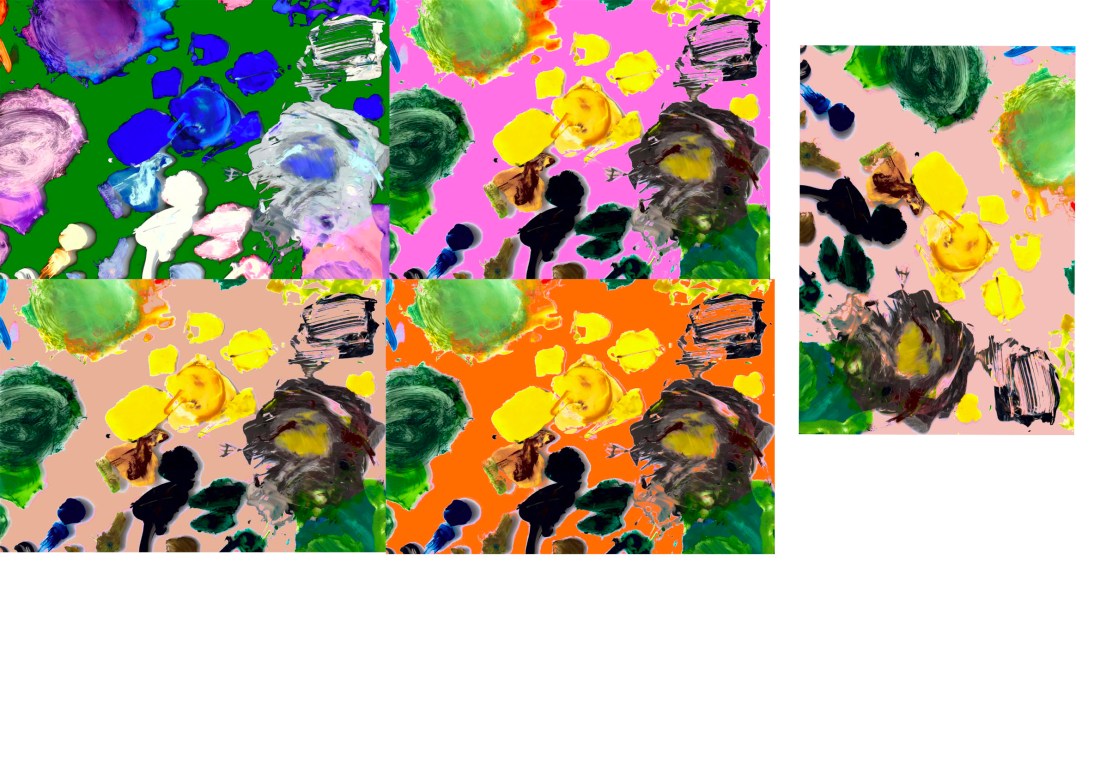
After visiting Pierre Bonnard exhibition, ‘The Colour Of Memory’ using his techniques such as brush strokes and bold colours to enhance the memories almost making them vivid to the viewer as though they where there at the time. I wanted to then develop these ideas to match my own theme using images of my nans flat and some of Bermondsey. While creating these responses i used acetate to mix my colours together for the images but found that when i turn’t the acetate over it created a mixed, messy floral pattern that looked like it had been blurred like in some of the research from my nans pictures. From this I have scanned in the work and played around with colours keeping the paint colours the same, however, changing the background. I wanted to choose the colours from the paint, to really show but also I looked on WGSN for the colour trend boards to see what colours I should be looking at. Also extracting colours from my nan’s flat especially from the wall paper. However, I really like the orange and bright pink responses. I have used the trend boards to make the colours extreme, using bold colours for it to stand out. I can develop this idea by maybe testing the prints onto fabric or maybe embroider the patter. print designs print

FMP Week 3-Experimenting with Knitting

From my primary research i have found a common piece of clothing that my nans has worn in the past and now. She always wears cardigans and used to knit in her spare time. To respond to this i wanted to challenge myself by knitting a pattern using a different colours so that the pattern stands out against the colour behind. Finding inspiration from her wallpaper and then to develop this idea into knit flowers to look like the wallpaper and the textures of her cardigan. My first challenge when using the knitting machine, was making the pattern clear to me and remembering how to separate the colour from each colour to create the pattern.  Looking back at my tutorials from diagnostic stage, of videos that i had recorded to help me in situations like this. The first few attempts i failed. Sometimes the knit would unhook or the pattern didnt look how i wanted it to be. So i had to problem solve and to help me i used graph paper and used each square as one stitch. By colouring in the blocks, it helped me to know what needles had what colour. I really like how the knit came out, the pattern was clear, that it was flowers, however, either the colour or the pattern i find boring, so to develop this further i will place this in photoshop and test with different colours to see if i could make it more interesting. As i know how to create patterns on the knit machine maybe i could try to abstract other shapes and objects from my nan’s flat and try creating a print with that object instead.

FMP Week 2 Exhibitions

This week I went to exhibitions such as Only Human: Martin Parr, Pierre Bonnard and Bedroom of London. I went and saw Only Human: Martin Parr for the understanding of social class. His photography looks at different scenes of social class but looking at people in their natural states instead of having someone posing. By this it made me feel that although he understood that he was taking pictures of the different classes, that actually by making them not pose made everyone in the images equal. One part that I found really interesting was the ‘Fotoesculturas.’ He looked at portraits and created a 3D model carve out of wood. I really liked this idea and wanted to develop it further by maybe making a 3D version of my nan or some of the objects in her house on fabric and stuffing it to almost make a pillow or doll. However, some of the exhibition didn’t help.  He took pictures of curtain events, such as Wimbledon and Celebrities which didn’t help with my research.

When I saw Pierre Bonnard exhibition was about memory, he would paint his memories of people and and scenes that he has of maybe a holiday or of his house. I wanted to use and respond to his techniques using paint and capturing moments, by applying with short strokes. Using a variety of colours to create shadows and lighting, not using the traditional colours such as white for lighting he would look at using lighter colours.

I then used some of my primary research from my nans flat to then use the techniques of Bonnard. I really like the painting that I done of my nan’s wallpaper looking at a closer version of the pattern on the wallpaper. I really liked the colours and the little flowers that I wanted to capture. I also notice that some of the wall paper is lighter because there was another picture placed there before. I was really interested by this mark because it shows the past and memories but also it shows how much my nan’s flat has changed as her children have grown up and the grandchildren. Also that she hasn’t got a lot of money to replace the wall paper.  I could develop this wallpaper further by creating a knit version as well as a embroidered version. However, I could develop more with the other painting of my nan’s firer place by using a smaller place and adding more detail or adding different colours visible layering the colours.